
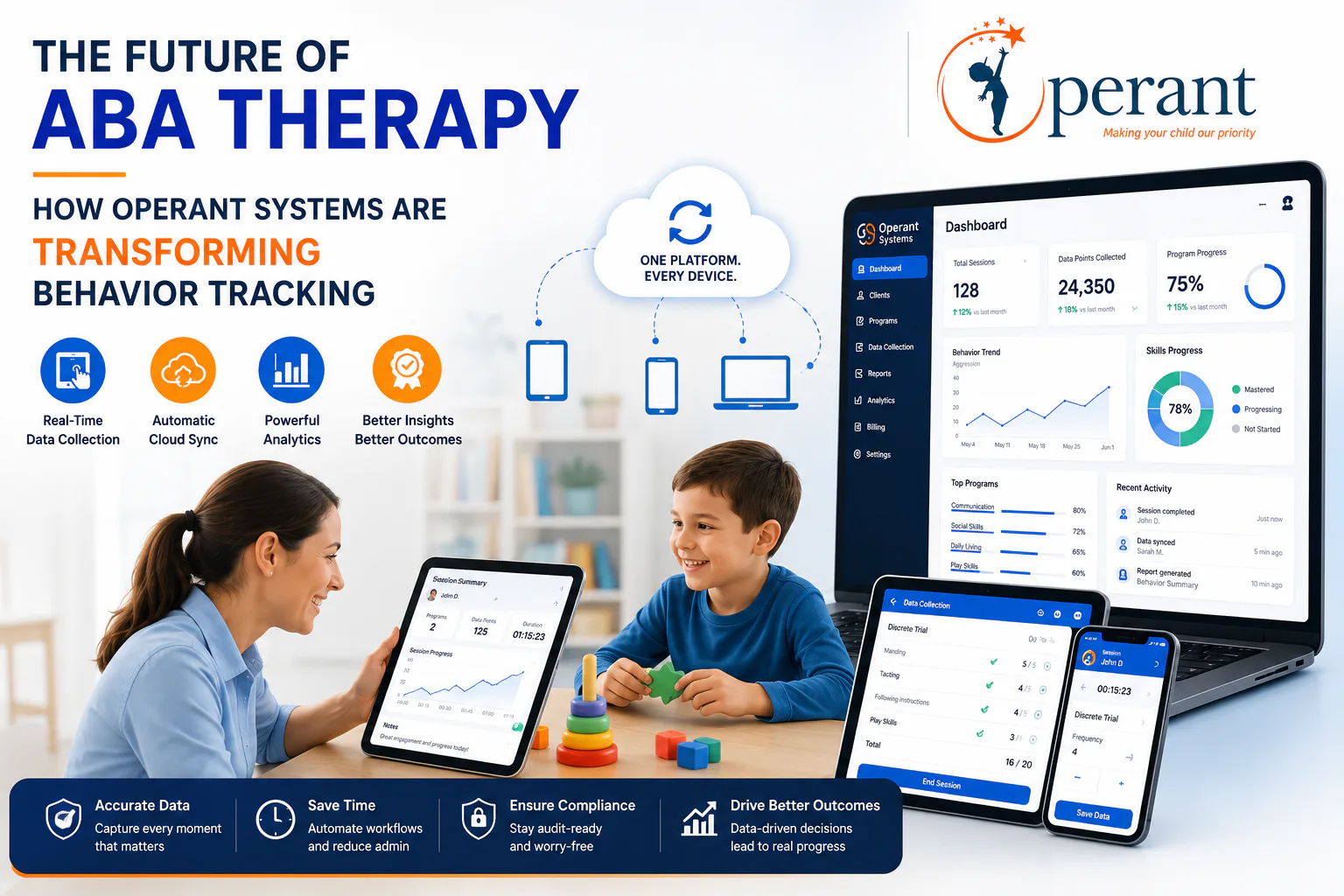
Running an ABA program today feels a bit like trying to juggle puzzle pieces while someone keeps swapping the picture on the box. Rules change. Payers update forms. Medicaid adds one tiny new requirement and suddenly half your treatment plans don't meet criteria anymore. And somewhere in the middle of it all, everyone still expects clean behavior data, fast reports, and perfect notes.
It's a lot. Actually, it's too much. And that's why behavior data systems matter now more than ever.
Operant Systems isn't just another ABA therapy software online. It's built around the real pressure points — the messy, stressful, financially-significant parts of the ABA world that people outside the industry never see.
Let's break it down. Simply. Like talking through it over coffee, with a notebook half open and someone saying "wait — hold on — go back" every few minutes.
Why Behavior Tracking Matters for Reimbursement
Insurance companies don't pay for "nice sessions." They pay for medically necessary, measurable progress that your documentation can prove.
If your data isn't accurate, consistent, and defensible, you lose money. Sometimes a lot of money.
A few common reasons clinics get denials:
- "Insufficient data to demonstrate progress"
- "Lacks objective behavior measurement"
- "Treatment plan goals not tied to measurable outcomes"
- "Session notes not aligned with behavior data"
- "Time stamps inconsistent with billing units"
This is exactly why Operant ABA tools hit different. The system locks in what you need to stay compliant:
- Duration data
- Interval data
- Frequency counts
- Clean graphs
- Phase-change markers
- Synced time stamps
- Session notes tied to actual behavior data
It's the kind of documentation auditors love — because there's nothing to argue about.
Treatment Plans That Don't Break Under Audit Pressure
Writing treatment plans is demanding. You want something clear, solid, and useful. Insurance wants something long, rigid, clinically perfect, and tied to measurable goals.
Operant Systems helps here in a significant way:
- Operational definitions written once, applied anywhere
- Goals linked directly to real-time data collection
- Mastery criteria spelled out
- Behavior strategies documented
- Reinforcement plans stored in one place
- Generalization plans already mapped
So when an auditor asks "How do you define this behavior?" — you don't dig through five binders or an old Google Doc. The definition is right there. And the data that proves the definition matches reality? Also right there.
Assessment Tools That Actually Guide Billing and Care
Assessment drives hours. Hours drive authorizations. Authorizations drive revenue. And revenue keeps the lights on.
Many clinics underestimate how important standardized assessments combined with clean data are for payer approval. Operant Systems supports:
- FBA data
- ABC logs
- Skill acquisition baselines
- Preference assessments
- Weekly and monthly behavior summaries
- Graphs that match payer expectations
Better assessments lead to better authorizations and fewer denials. Simple math.
A Quick Overview: How Operant Systems Fixes Common Problems
| Industry Need | Problem Clinics Face | How Operant Systems Fixes It |
|---|---|---|
| Reimbursement | Denials from poor data | Time-stamped, defensible behavior data |
| Treatment Plans | Inconsistent definitions | Operational definitions + mastery rules |
| Session Notes | Missing details | Notes tied to actual session data |
| Assessments | Hard to justify hours | FBA + baseline + ABC + trend graphs |
| Staff Accountability | Missed data, errors | Mobile data capture + offline sync |
| Billing | Time mismatches | Auto-synced time logs + clean reports |
Behavior Data That Actually Matches What Payers Want
Behavior tracking isn't about pretty graphs. It's about proving progress — or regression — so the treatment plan stays medically necessary. Operant Systems gives you:
- Phase-change lines so you can prove treatment adjustments
- Trend lines to show how intensity relates to progress
- Interval data that demonstrates objective measurement
- Duration data for high-impact behaviors
- Export-ready reports that match the formats payers expect
No more scrambling before re-auth. No more guessing. No more explaining why someone forgot to track something last week.
Session Notes That Match Behavior Data
One of the biggest payer red flags is when session notes don't match the data. For example: a note saying "client engaged in aggressive behavior throughout the session," but the data shows zero instances. Insurance responds with a denial.
Operant Systems fixes this with:
- Notes written inside the same system as the data
- 1,000-character notes tied to actual events
- Signatures and timestamps
- Past session visibility
- Auto-sync so nothing disappears
Everything lines up. Everything matches. Everything passes audit.
The Future: Less Admin Time, More Clinical Time
ABA is moving fast. Clinics that don't modernize are going to struggle — not because they're delivering poor care, but because payer rules are tightening, costs are rising, and staff burnout is real.
The future looks like this:
- Less paper
- More defensible data
- Fewer denials
- Cleaner audits
- Treatment plans written faster
- Assessments backed by live data
- Mobile data tracking in the field
- Dashboards that surface risk areas before they become denials
This is where Operant Systems is already ahead. The software does the things payers are going to require soon.
Why This All Matters Now
Success in ABA used to be about good clinical work. Now it requires good clinical work plus:
- Strong documentation
- Billing accuracy
- Payer compliance
- Proof of progress
- Audit readiness
- Fast reporting
- Staff accountability
- Treatment plans rooted in real data
Clinics that balance both sides survive. Clinics that automate the heavy lifting thrive. Tools like Operant Systems make that possible without drowning your team in admin work.