
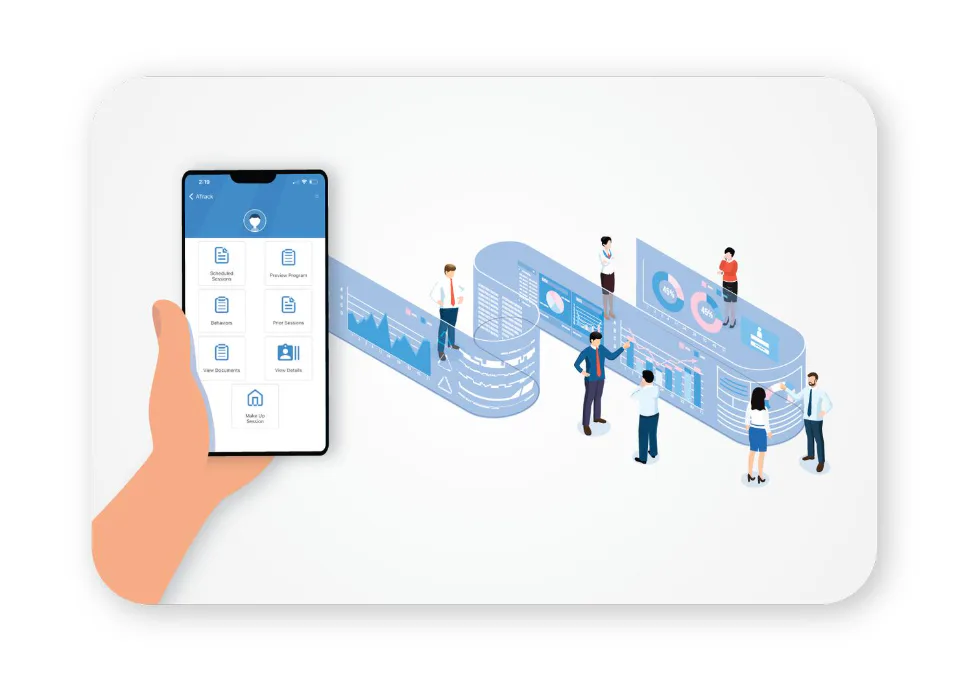
A behavior technician finishes a session at a client's home and realizes the data she collected on her tablet never synced. The BCBA supervising the case is working from a laptop across town. The program updates made yesterday aren't visible on the field device. The session may as well not have happened.
For many ABA clinicians, this is their daily reality. Across the industry, disconnected and single-platform software has quietly become one of the biggest barriers to consistent, high-quality ABA care. Studies show that over 70% of ABA providers work across more than one setting, yet most are still relying on tools that were never designed for multi-platform delivery.
Fragmented software isn't just an inconvenience. It makes an already demanding job harder in an industry that's ready for smarter, more connected tools. When your tools don't talk to each other, it doesn't just create extra steps; it disrupts care, delays billing, and limits your practice's ability to scale.
Why Platform Fragmentation Is an Organizational Risk
Most practices recognize software as a documentation requirement. But disconnected ABA therapy software online impacts far more than recordkeeping. It affects staff efficiency, clinical outcomes, and practice revenue.
1. Disrupted Care and Clinical Continuity
Working across mismatched platforms creates what many clinicians describe as a constant "catch-up" cycle. RBTs re-enter data manually. BCBAs review outdated graphs. Supervisors make decisions based on information that's hours or days behind.
A skill acquisition program is only as good as the real-time data informing it. When platforms don't sync, clinical decision-making suffers. Research consistently shows that care fragmentation, even at the software level, is linked to poorer client outcomes and higher clinician frustration.
2. Compliance Risk and Billing Delays
ABA documentation must meet strict payer standards. But when data is collected on one device and notes are written on another, alignment breaks down, and that has real financial consequences.
Common risks include:
- Session data is lost when devices lose connectivity mid-session
- Errors of manual re-entry are introducing dissimilarities between documented information and session notes
- Missing documentation elements due to platform gaps
- Inconsistent records that trigger payer audits or claim denials
Most compliance issues aren't knowledge problems. They're platform problems.
3. Operational Inefficiency and Financial Impact
Fragmented software consumes valuable clinical time. If a clinician spends an extra 20 minutes per day reconciling data across platforms, that compounds fast. Across a team of ten, that's over 80 hours every month spent managing software instead of delivering care.
That lost time could support supervision, training, or additional client sessions. Platform inefficiency isn't just an inconvenience. It's costing ABA practices real money.
4. Limited Capacity for Growth
When clinicians are navigating disconnected tools, they have less bandwidth for what matters. Supervisors troubleshoot data gaps instead of coaching staff. BCBAs chase missing records instead of analyzing treatment trends. Administrators reconcile conflicting reports instead of planning for growth. Fragmented software doesn't just slow teams down. It caps what they're able to build.
Why Traditional Fixes Fall Short
When platform problems surface, most ABA organizations respond the same way. They add a workaround. They create a manual sync process. They ask clinicians to log data in two places. For a while, it feels manageable. Then a session's worth of data disappears. A billing claim gets denied. A BCBA realizes she's been reviewing last week's graphs. That's because platform fragmentation isn't a process problem, it isn't a training problem, and it isn't a staffing problem. It's a structural problem, and small fixes don't change the structure.
How to Fix It: Three Shifts That Make the Biggest Difference
Organizations successfully eliminating platform fragmentation are focusing on integration rather than workarounds. Here are three practical changes making the biggest impact.
1. Move to a Truly Device-Agnostic Platform
The most effective multi-platform ABA therapy tools work identically across iPad, Android, Amazon Fire, and web browsers. Data collected on any device is immediately accessible from every other, no manual export, no re-entry, no reconciliation. When clinicians aren't managing their tools, they focus on their clients.
2. Prioritize Offline Functionality and Auto-Recovery
Real-world therapy environments don't always have reliable internet. The right ABA therapy software online collects data offline and syncs automatically when connectivity returns. If a device loses power mid-session, auto-recovery ensures nothing is lost. This isn't a feature — it's a clinical safeguard.
3. Integrate Clinical and Operational Workflows in One System
When session data flows directly into program management, reporting, and billing, all within one platform accessible from any device, documentation time drops, compliance strengthens, and the practice runs more efficiently at every level.
The Future of ABA Therapy Is Multi-Platform
The demands on ABA organizations will continue to grow. Payers expect stronger documentation. Telehealth delivery is expanding. Clinician capacity is already stretched. Investing in truly multi-platform ABA therapy software means protecting data integrity, reducing manual burden, strengthening compliance, and supporting growth without rebuilding infrastructure at every stage. For ABA organizations ready to move beyond fragmented tools, a truly connected platform is the clearest path forward.